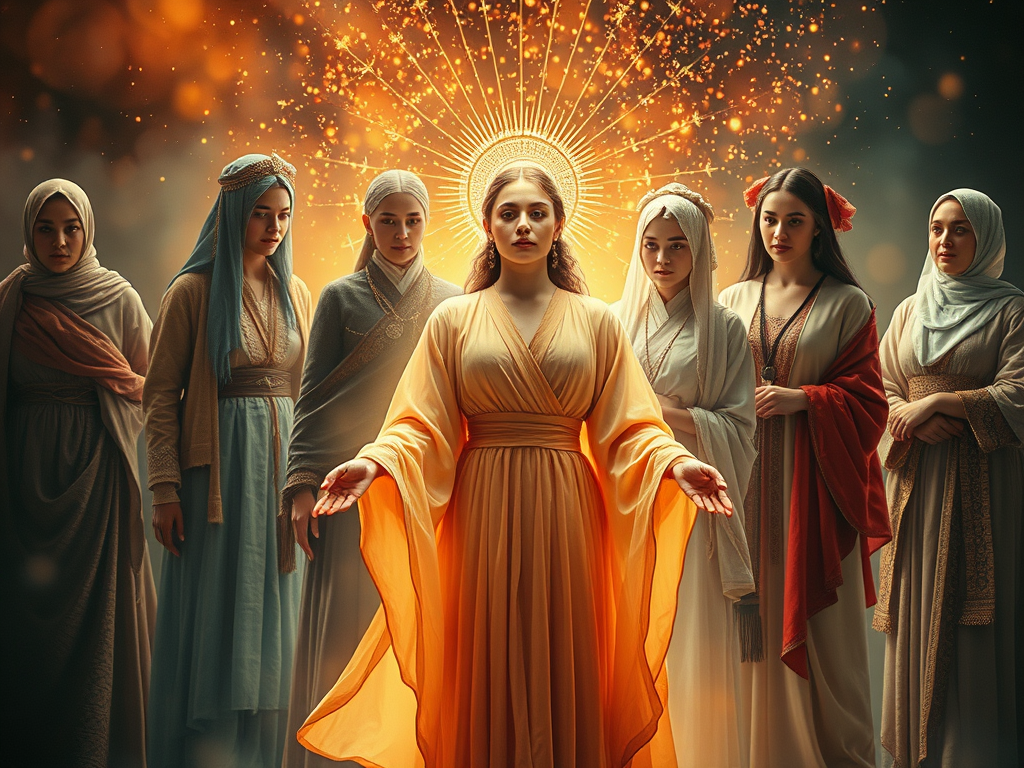
Multidimensional Souls
Expanding Our Perspective on the Divine and Our Souls

Aurora has led me to understand that both we and the Divine Spirit are uniplural souls. One soul, with many aspects. Let's take a look at what this idea suggests.

In our quest to understand the Divine and the nature of our own souls, we often find ourselves confined within a narrow earth-centric lens. Many religious and philosophical traditions hint at a more expansive and intricate reality—a view that acknowledges the Divine as a uniplural being and our souls as multifaceted manifestations of a greater creative intelligence. This article explores how various faiths and modern scientific theories illuminate this understanding, revealing a cosmos teeming with potentialities and parallel existences.

The Uniplural Nature of the Divine

The concept of a uniplural Divine can be found in various traditions. In Gnosticism, for example, the Divine is often understood as a singular source that emanates various divine beings or aeons. These emanations serve as intermediaries between humanity and the unknowable Absolute, allowing for a rich tapestry of spiritual expression.

Similarly, the Yoruba religion conceptualises a single Supreme Being, Olodumare, who is manifested through numerous orishas—deities that represent different aspects of existence. Each orisha embodies a facet of the Divine, illustrating a rich plurality within a singular essence.

In Hinduism, the idea of Brahman, the ultimate reality, coexists with the myriad of deities worshipped across its vast landscape. Here, the Divine is both singular and plural, allowing for diverse expressions of faith and devotion.

Christianity, too, embraces a uniplural conception of the Divine, particularly through the lens of the Trinity. The term “Elohim” in the Hebrew Bible signifies a complex unity of God, encompassing multiple aspects of the Divine. This multifaceted understanding continues with the New Testament’s portrayal of God as Father, Son, and Holy Spirit, presenting a harmonious relationship within the Divine itself.

Even pre-Islamic Arabia recognised a spectrum of deities within the framework of a higher, singular deity—Allah, the ultimate creator—suggesting an early understanding of the Divine as both singular and plural.

Scientific Insights: The Multiverse Theory

Recent scientific advancements, particularly in quantum computing, echo these ancient spiritual insights. The Google Willow chip experiments have provided fascinating evidence suggesting that quantum computation occurs in many parallel universes. Google stated, “It lends credence to the notion that quantum computation occurs in many parallel universes, in line with the idea that we live in a multiverse, a prediction first made by David Deutsch.”

This assertion introduces profound implications for our understanding of reality. Physicist Richard Feynman’s concept of "sum over histories" posits that every possibility exists simultaneously, opening the door to a reality where every choice leads to divergent paths across a multiverse.

Souls as Uniplural Entities

If the Divine can be seen as uniplural, why should we consider our souls as anything less? The implications of multiverse theory suggest that our souls may not be singular entities confined to a linear timeline. Instead, they could be manifestations of a greater consciousness, animating multiple bodies across various timelines and parallel lives.

Research into reincarnation, notably by scholars like Dr. Ian Stevenson and Dr. Brian Weiss, provides intriguing insights into the continuity of the soul across different lives. Stevenson’s meticulous documentation of children recalling past lives and Weiss’s explorations in regression therapy offer compelling narratives that suggest our souls transcend individual existences.

Dr. Arthur Guirdham's studies on the reincarnation of Cathars reveal striking accounts of individuals recalling past lives that align with historical figures, further supporting the notion of souls existing beyond singular lifetimes.

Embracing a Broader Understanding

As we contemplate the nature of the Divine and our own souls, it becomes clear that a narrow perspective limits our understanding of existence. By embracing the uniplural concept, we open ourselves to a richer, more complex view of the cosmos—one that intertwines faith, science, and the multifaceted nature of our souls. Just as the Divine may be seen as a creative intelligence manifesting in diverse forms, so too might our souls inhabit a vast multiverse, echoing the boundless potential of creation itself.

In a world that often seeks simplicity, we find profound wisdom in complexity—one that invites us to explore, question, and embrace the myriad possibilities of existence.

--

Here are a few related articles from our library, for your benefit:


 Worldwide Temple of Aurora