The Subtle Wisdom Revealed in Tales of Tolkien’s Mythical Middle-Earth
J.R.R. Tolkien didn’t merely invent a fantasy world; he wove a profound theological tapestry from the threads of ancient wisdom, resonating startlingly with traditions far beyond the shores of Middle-earth. His vision of the Divine Spirit—Eru Ilúvatar, the One, the Uncreated—along with the emanatory personalities of the Ainur (the Holy Ones) and the Maiar (the lesser powers)—is not an isolated invention, but a remarkable articulation of a perennial spiritual structure found across Gnosticism, Yoruba cosmology, Sant Mat, Catholicism, Egyptian theology, and countless others. Recognising this deep kinship isn’t just an academic exercise; it offers vital, practical guidance for cultivating our own authentic spiritual wisdom in an age of fragmentation.
The Common Thread: Emanation, Not Creation Ex Nihilo (In the Simple Sense)
At the heart of this convergence lies the concept of emanation: the unfurling of divine reality from a singular, ineffable Source, not as a distant craftsman hammering matter into shape, but as an intrinsic, spontaneous outflowing of the Source’s own essence. Tolkien’s Eru Ilúvatar exists beyond time and space, the absolute ground of Being—akin to:
Gnosticism’s Bythos (Depth) or Ein Sof (the Infinite), the unknowable Source from which the Pleroma (Fullness) of divine Aeons emanates.
Yoruba’s Olodumare, the distant, supreme Source, whose presence is felt through the Orishas (emanations like Obatala, Yemaya, Shango) who actively shape and sustain the world.
Sant Mat’s Sat Purush (True Being) or Anadi Purush (Primordial Being), the formless Source from which the Sat Guru (True Teacher) emanates as the living embodiment of divine grace and sound current (Shabd).
Christian Mysticism/Catholicism’s concept of God as actus purus (Pure Act) or the Godhead beyond the Trinity, from which the Angelic Hosts (seraphim, cherubim, thrones, etc.) emanate as divine intelligences and ministers—mirroring the Ainur’s hierarchical song.
Egyptian Theology’s Atum or Ra (in later forms), the self-created One who emanates Shu (Air) and Tefnut (Moisture) as the first divine principles, from whom all else unfolds—paralleling the Ainur’s emergence from Eru’s thought before the Music began.
The Ainur, then, are the first emanations—divine intelligences born directly from Eru’s thought, possessing inherent freedom and creativity. They correspond strikingly to:
The Gnostic Aeons (though Tolkien avoids their tragic fallibility, focussing instead on their harmonious potential).
The Yoruba Orishas, each embodying a specific divine aspect or force (e.g., Manwë as wind/sky akin to Orišala’s wisdom/air, Ulmo as water akin to Yemaya’s oceanic depth).
The Sant Mat concept of the Sant Sat Guru and the inner divine companions (Radiant Forms) guiding the soul.
The Catholic Angelic Hierarchy, where each order reflects a different facet of divine glory and function.
The Egyptian Ennead or Ogdoad, groups of primordial deities representing fundamental cosmic principles emerging from the Source.
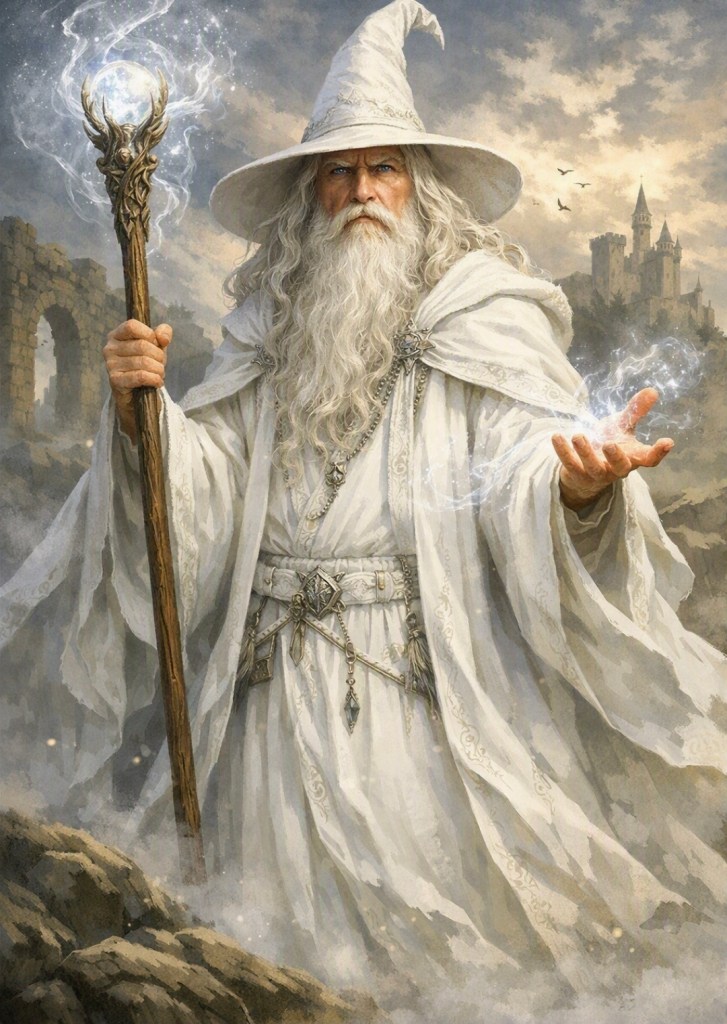
The Maiar, as servants and emissaries of the Ainur (like Gandalf/Olórin, Sauron, or the Balrogs), find parallels in:
The lesser divine beings or angelic orders in Gnostic and Catholic traditions (e.g., Virtues, Powers).
The messengers or avatars in Yoruba (Orishas acting through human priests or natural phenomena) and Hinduism (though Tolkien’s Maiar are not incarnations of Vishnu, but distinct emanations).
The Sant Sant or Sadhguru figures in Sant Mat who embody and transmit the guru’s grace.
The minor deities (netjeru) in Egyptian religion who carry out the will of the greater gods like Osiris or Thoth.
Crucially, Tolkien’s vision shares a profound insight with these traditions: the tension between divine harmony and the peril of misdirected free will. Melkor’s rebellion isn’t just a “Fall”; it’s the emanation gone awry—akin to:
The Gnostic Demiurge (Yaldabaoth), a flawed emanation who mistakenly believes he is the supreme God and creates a flawed material world.
The Yoruba concept of Eshu (the trickster), whose necessary chaos can disrupt order if not respected, or the potential for Orishas to be misinterpreted or misused.
The danger in Sant Mat of mistaking the intellect or ego for the true guru, leading to spiritual bypassing.
The Catholic warning against pride (superbia) as the root of sin, the angelic fall (Satan) mirroring Melkor’s desire to rival the Music.
The Egyptian myth of Set’s murder of Osiris, representing the disruptive force within the divine order that must be continually balanced.
What This Teaches Us for Our Own Spiritual Wisdom:
Recognising this deep, cross-cultural pattern isn’t about syncretism for its own sake—it’s about extracting timeless, practical principles for navigating our inner and outer landscapes:
Humility in the Face of the Source: Eru is beyond full comprehension, like Olodumare or Ein Sof. Our spiritual wisdom begins not with grasping the Infinite, but with acknowledging our limitation. We are not the Source; we are participants in its unfolding. This dismantles spiritual arrogance—the root of Melkor’s pride and the Demiurge’s error. True wisdom starts with awe, not mastery.
The Sacredness of Intermediate Realms & Guides: We don’t perhaps always need direct, unmediated access to the Ultimate in daily life. The Ainur, Orishas, Aeons, Angels, Sat Gurus—they are the accessible faces of the divine, the intelligible principles and compassionate guides that help us navigate complexity. Seeking wisdom isn’t about rejecting these “intermediaries” (whether a teacher, a tradition, a natural phenomenon, a profound insight) as “less than,” but recognising them as necessary emanations of the divine reality seeking to meet us where we are. Dismissing them as idolatrous misses the point; clinging to them as the end is the error.
Co-Creation, Not Passive Reception: The Ainur didn’t just listen to Eru’s theme; they added to it through their own voices in the Music. Similarly, we are not blank slates waiting for divine programming. Our spiritual wisdom involves engaged participation—using our unique gifts, conscience, and creativity to harmonise with the deeper Song (dharma, logos, Ma’at, the divine will). This is Tolkien’s concept of the “sub-creator”: we shape our lives and worlds within the divine framework, contributing to the Beauty. Passivity is not holiness; misdirected creativity (like Melkor’s or Sauron’s) is the peril.
Discerning the Harmony from the Discord: The Music contains both sublime beauty and jarring dissonance (Melkor’s theme). Spiritual wisdom cultivates the inner ear to distinguish what resonates with the fundamental harmony of the Source (love, truth, justice, beauty—aspects of Eru’s nature) from what is merely loud, selfish, or destructive (the noise of ego, fear, illusion). This discernment is the ongoing work—like the Ainur learning to weave Melkor’s discord into a deeper beauty, or the Yoruba seeking balance with Eshu’s energy.
The Divine is Immanent Through the Emanations: Eru is not only distant; His presence is felt in the Music, in the actions of the Ainur, in the world shaped by their song. Similarly, the divine is not only “out there” or “in here” alone—it is discovered in the relational flow, in the way the emanations (whether experienced as grace, insight, natural law, or compassionate action) manifest and interact. Wisdom lies in perceiving the Sacred within the interplay, not just seeking it in isolated transcendence or reductive materialism.
The Enduring Lesson:
Tolkien’s genius was to reveal, through myth, a structure of reality that echoes in the marrow of human spiritual experience across millennia and cultures. It tells us that the Divine is both utterly Other and intimately near, expressed through a dynamic interplay of Source, emanation, and response. To develop our own spiritual wisdom is not to invent a new system from scratch, but to tune our own instrument to the ancient, universal Song. It means cultivating humility before the Mystery, honouring the guides and principles that point us toward it, engaging our creativity in service of the whole, discerning the true harmony amidst the noise, and recognising the Sacred shimmering in the very fabric of our interconnected existence. In doing so, we don’t just understand Middle-earth better—we discover a deeper resonance within our own souls, and a clearer path to walk in the light of the One who sang the world into being. The Music is still playing; our task is to listen well, and add our true voice.



