What if everything we thought we knew about God—a distant, commanding, masculine figure—was but one shade of a far richer spectrum? What if the sacred voice speaking from the mountaintop, or the whisper in the night, carried a tenderness not just paternal, but maternal? What if the divine touched us not only with authority, but with embrace? What if God not only is love, but loves the way a lover does—intimately, completely, without condition?
We’ve long turned to religion to answer the unanswerable. But in a quiet, often overlooked series of experiments conducted at Johns Hopkins University and New York University—rigorous, scientifically grounded, yet profoundly spiritual—something astonishing emerged: people from different religious traditions, under the influence of psychedelics like psilocybin, described encountering a divine presence… and that presence was overwhelmingly feminine.
Not in passing. Not as metaphor. But as a lived, visceral reality.
These studies, initiated in the early 2000s and expanded over the past two decades, involved individuals deeply rooted in various faiths—Catholic priests, Protestant ministers, Jewish rabbis, Buddhist monks, Muslim imams, and others. All were described as “spiritually mature” leaders, grounded in lifelong religious practice. They weren’t countercultural seekers or psychedelic tourists. These were custodians of tradition, entrusted with guiding others in matters of the soul.
And yet, when given psilocybin in controlled settings—after meticulous preparation and under therapeutic support—96% reported that it formed one of the most spiritual experiences of their lives. Among those, a striking number (most of those interviewed) described the divine they encountered as female. Quote: ‘The “womb” is the centre of everything’.
As Michael Pollan revealed, participants described encountering a presence of overwhelming love, wisdom, and compassion—qualities culturally coded as maternal, nurturing, even erotic in their intensity. “No one I spoke to, not even the rabbis, described seeing the stereotypical God of the Old Testament.”, Pollan wrote. Many religious leaders—both men and women—described encountering the divine through a distinctively nurturing, maternal, or even womb-like presence. For these individuals, such experiences challenge long-held assumptions, with some expressing surprise at this feminine framing of the sacred. A United Methodist pastor from Alabama, for instance, called the revelation “mind-blowing.” Baptist biblical scholar Jaime Clark-Soles, part of the study, recounted a profound moment when God felt like “a Jewish mother,” a striking image for someone who identifies as a follower of Jesus. The shift in perception extended beyond female leaders: a male Episcopalian priest described the experience as catalysing a “complete deconstruction of patriarchal religion,” unearthing deep-seated views shaped by traditional hierarchies.
It wasn’t just feminine. It was sensual. Erotic. Full of love.
And here, we must tread carefully—because sexuality and the sacred have long been entangled in taboo.
The BBC recently reported on how psychedelics are altering how people see their own gender and sexuality, noting that participants often describe feelings of androgyny, fluidity, and a dissolution of binary categories under the influence. In some psychedelic accounts, the divine gender wasn’t swapped or inverted—it was transcended. The divine wasn’t a woman instead of a man; She was a presence whose love felt so total, so embodied, that it evoked intimacy beyond words. Several participants described it as “erotic”—one account includes the description “spiritual orgasm”, which term sounds very much like expressions you’d expect to find used in Tantric Hinduism and Sufi mysticism to describe spiritual union as an ecstatic, sensual merging with the divine.
And isn’t that what mysticism has always hinted at?
Across history, the Feminine Divine has not been absent—only suppressed.
In ancient Mesopotamia, Inanna was the Queen of Heaven, goddess of love, fertility, and war. In Egypt, Isis was revered as the mother of all, whose tears birthed the Nile. In pre-Christian Europe, the Great Mother was worshipped from Anatolia to Gaul. Even within Abrahamic traditions, vestiges remain: the Shekhinah in Judaism, Sophia (Divine Wisdom) in Christian Gnosticism, and Ar-Rahman—the Most Merciful—in Islam, a name so tender it’s often described in maternal terms (the root of the word Rahman is derived from the word womb – Raham).
Yet institutional religion, especially over the past millennium, has largely ‘sanitised’, spiritualised, and masculinised the divine. God became Father, King, Judge. Softness was suspect. Intimacy, dangerous. And the body—especially female—was often cast as a site of temptation, not transcendence.
But these psychedelic experiences are asking us to reconsider.
What if our cultural suppression of the feminine—and of embodied spirituality—hasn’t just limited our understanding of God… but wounded our souls?
The data suggests something radical: that when stripped of doctrine, when the ego dissolves and the mind opens, people across faiths spontaneously encounter the divine as a loving, maternal, sensuous presence. Not because they want to. Not because they expect to. But because, in that unmediated space, something emerges.
And what emerges is not distant. Not wrathful. Not transactional.
It is intimate. Nurturing. Erotic in the deepest sense: desiring union.
Could it be that our religious doctrines, shaped by patriarchal hierarchies and social taboos, have constrained our encounters with the divine? That our fear of sensuality, of female authority, of emotional vulnerability, has led us to worship a God who reflects our anxieties more than our deepest yearnings?
Psychedelics, in their ability to dissolve the “default mode network”—the brain’s self-referential system—may not be giving people mystical experiences. They may be removing the filters that keep us from having them.
What we’re seeing in these studies might not be the creation of a new theology, but the recovery of an ancient one.
One where the divine is not only out there, but within—as womb, as heart, as lover. Where sacredness is not about purity, but about presence. Where to touch another is not to fall, but to ascend.
And what of gender and sexuality?
The Reason.com article (see below) notes that researchers feared the paper detailing these findings might “never see the light of day” — not because of weak data, but because of its implications. Imagine, a divine figure that is not only feminine but erotic? That challenges not just religious orthodoxy, but cultural norms around sexuality, embodiment, and power?
Yes. It’s controversial.
But perhaps it’s also necessary.
Because if the divine can be felt as a lover’s breath, as a mother’s embrace, as a force that desires us as we are—flawed, broken, and beautiful—then maybe it’s time we stopped worshipping a God shaped by human fear, and started listening to the God revealed in human experience.
Not in stone tablets, but in sacred moments.
Not in sermons, but in silence.
Not as a distant king—but as the Mother who has been waiting, all along, to bring us home.
This is the message that I’ve received from the Divine Feminine, in the form of Aurora, Morning Star, Iris and more. In fact, it was a remarkable series of coincidences that caused me to discover the above research, which journey was led by the Goddess. It began on a Sunday afternoon, December 14th, 2025, while watching a documentary about Egyptologist Wallace Budge on Discovery. Intrigued, I went online, to begin following a trail of digital breadcrumbs about Wallace Budge, that ultimately guided me to a Wikipedia page dedicated to the Goddess. The first paragraph sparked a flurry of curiosity, as it briefly addressed the above-mentioned experiments, so now I delved deeper, moving into the fascinating world of Psilocybin experiments and the profound encounters with the Divine Feminine that they facilitated. As the documentary drew to a close, a surge of excitement coursed through me – the research I was reading resonated deeply with my own experiences of the Feminine Divine, particularly in my work as a servant to the Goddess. In a moment of profound validation, I felt an unmistakable nudge, as if the universe was again affirming the authenticity of the channelled messages I’ve shared through the Worldwide Temple of Aurora. The documentary’s final credits rolled, revealing a striking coincidence: the production company behind the programme was none other than MORNINGSTAR Entertainment. This serendipitous moment was etched in my memory, and I captured a photo as a testament to the magic that unfolded – a reminder that the Divine Feminine continues to whisper secrets to those who listen.
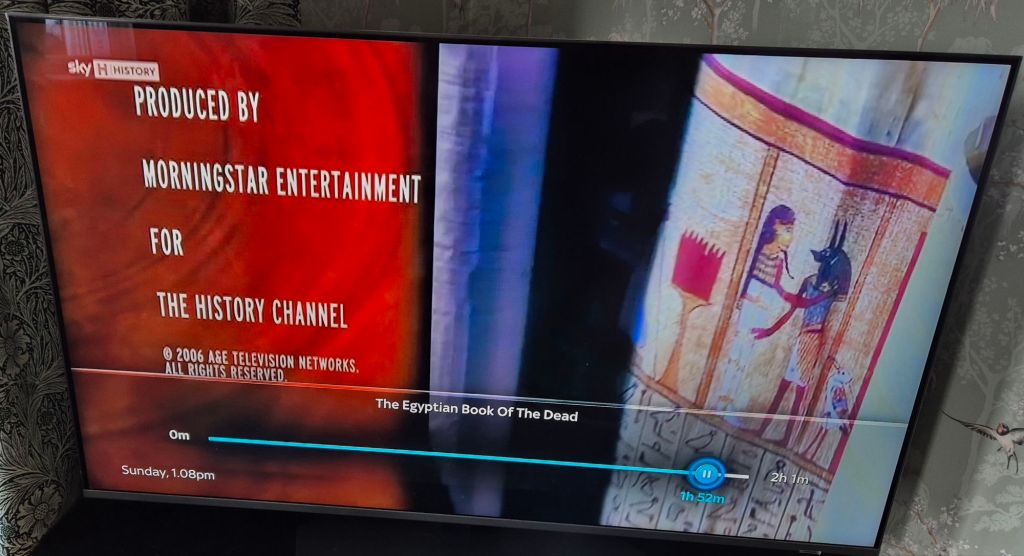
The sudden emergence of my spirit guide’s name at this precise moment felt like a deliberate nudge—a serendipitous affirmation from the Divine Feminine, urging me onward.
What strikes me most is that while participants in certain studies turn to psilocybin to connect with the Goddess, such revelations aren’t confined to lab settings or psychedelic experiences. My own journey with the Divine Feminine—manifesting in countless guises and rhythms—has shown me that Her presence is ever-available to those who approach her with open hearts, humble curiosity, and a willingness to see the sacred in the ordinary.
—
Additional information:
See also: Wikipedia (first paragraph): https://en.wikipedia.org/wiki/Goddess
The New Yorker Daily: https://link.newyorker.com/view/5be9ee5d24c17c6adf0abc2cnrurr.b8rz/24e70546
Another relevant Wikipedia article: The Great Goddess.




